Grace is rising and revealing the real Pocahontas
Grace is rising and revealing the real Pocahontas
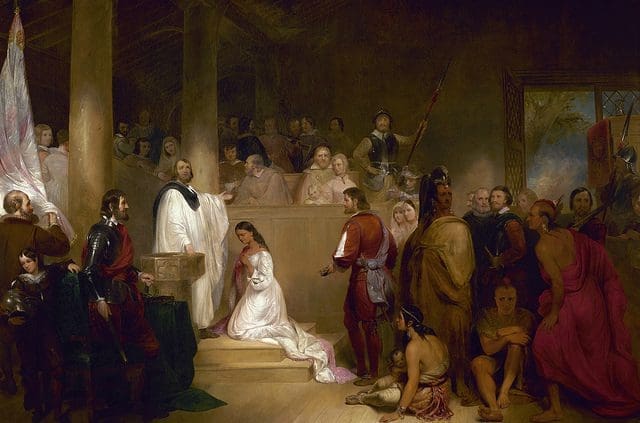
In 1837, the United States Congress commissioned a painting. It was to be a large historical work and it was to be hung in one of the most visible places possible, the Capitol rotunda. It was called “The Baptism of Pocahontas.” It depicts Pocahontas, still the most famous indigenous woman in American history, dressed in white, kneeling demurely before the font in the Anglican church of Jamestown, Virginia, surrounded by a host of white men.
As so often happens in art, the image captures a universe of questions and meanings. Pocahontas was chosen as the subject of the painting because, in 1837, the United States was carrying out the forced migration of tens of thousands of indigenous people on what has come to be known as The Trail of Tears. Her painting helped to add political cover for acts of genocide by being a visual and mythical distraction.
In reality, four years after the real Pocahontas died in England, her memory was already distorted by a racial slur that is as enduring as her legend: squaw. That word first appeared in English usage in 1622. The word in the Algonquin language means a woman or a person, but by 1622 the term had been appropriated by the colonizers to describe someone who was little better than a sex slave. It demeaned Native American cultures generally and indigenous women specifically.
Only one woman was exempt.
“The Baptism of Pocahontas” is an icon of racism. It masks the reality of how indigenous women were oppressed and exploited by offering up the idealized portrait of the perfect squaw. She is presented as docile, subservient, and totally dependent on the men around her. She has put on their color and adopted their customs.
Long before her name was invoked by a troubled President or sanitized by Disney, Pocahontas was already an image that pointed us away from the truth. She has remained so for generations and for the same reason. She is the myth that makes indigenous women disappear.
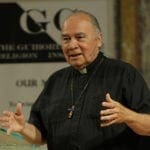 —Bishop Steven Charleston
Member, Choctaw Nation of Oklahoma; Visiting Professor of Native American Theology, Saint Paul School of Theology; and Advisor, The Guibord Center